Worlds That Grow and Expand
The first two Cat Who Hated stories were fun to write. Halloween, Thanksgiving — good ideas, enjoyable characters. But by the third book I knew something was wrong.
The world felt hollow. Too easy. Too light.
Shadow's dry wit was working. Bandit was working. The lane had personality. But the stories weren't good enough yet, and I knew it.
So I went looking — which, for me, usually means going back.
Most of my characters are drawn from life. Shadow is modeled after my daughter's fat, grumpy black cat. Ms. Graves is modeled, at least partly, after my mother. Mrs. Jinglebright after another family member. Bandit is essentially Tigger — boundless enthusiasm, zero self-awareness, inexplicably essential.
The three kids — Maya, Riley, and Eli — are my own children. Most of my books feature either one child or all three, built around their personalities. The Cat Who Hated series has all three, though only one of them is named after one of my kids directly. I'll let you figure out which one.
But none of that was what was missing.
What was missing was someone who could make Shadow miserable.
Not an enemy. Not a villain. Something worse — a colleague. Someone smarter, smugger, always a step ahead, always right, and deeply aware of all of it.
Growing up, I loved the Brave Little Toaster. My favorite character was Kirby the vacuum — the grumpy old veteran among younger, cheerier appliances. He reminded me of my grandfather. Big man. Hands that felt like rocks. Hugs that were completely inescapable. Dry, sharp humor. And always, always just a little smarter than whoever he was talking to.
I wanted that energy in the basement of Ms. Graves's Victorian farmhouse.
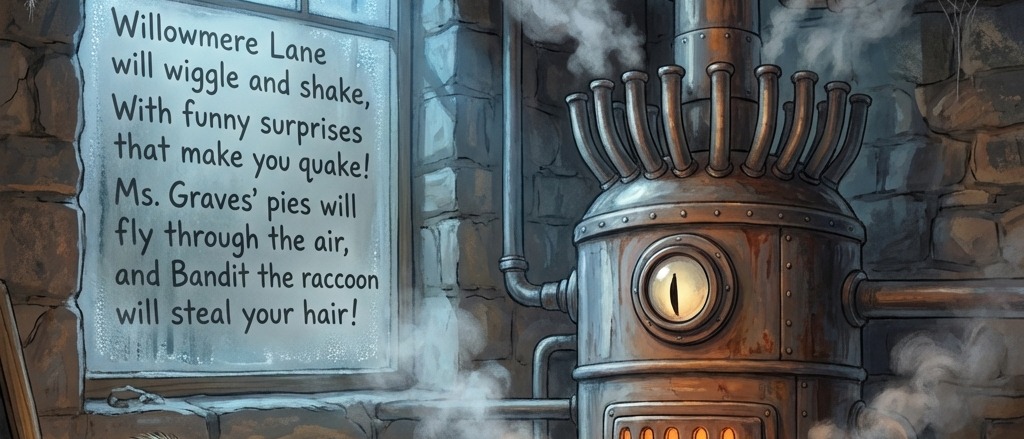
The Furnace was born — a rusting, converted coal furnace with the smugness of Kirby, the bone-dry wit of my grandfather, and just a touch of Thanos. I am inevitable. That part felt exactly right for a near-omniscient oracle who lives in the dark and waits for everyone else to catch up.
Then came the question of how the Furnace would speak.
I'd been looking for a way to weave real poetry into these stories for a while — not soft, decorative poetry, but poetry with teeth. Poetry that cuts. Poetry that holds clues and life lessons wrapped inside snark, the kind boys might actually read and remember.
Making the Furnace a poet solved two problems at once.
Shadow hates poetry. He wants plain language, direct answers, simple facts. The Furnace gives him rhyming verse, every single time, about things Shadow desperately needs to understand. It is, from Shadow's perspective, the most irritating possible communication style.
From the reader's perspective, it's the part they quote back to me.
"Noted, you overblown basement toaster."
"YOU'LL THANK ME WHEN I'M RIGHT! AGAIN!"
He is always right. That's what makes it perfect.
This is what I mean when I say worlds grow. You start with good characters and a fun idea. Then you go looking — in your own memories, your own bookshelf, your own grandfather's handshake — and you find the thing the story was waiting for all along.
The Furnace was waiting in that basement from the beginning. It just took me three books to hear him banging on the pipes.